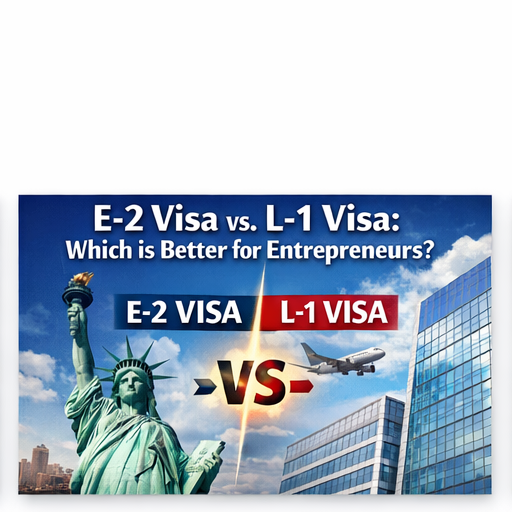
Entrepreneurs looking to expand their businesses into the United States often encounter two popular visa options: the E-2 Treaty Investor visa and the L-1 Intracompany Transfer visa.
While both visas allow foreign business owners to live and work in the United States, they are designed for very different types of business situations.
Understanding the key differences can help entrepreneurs choose the most appropriate immigration strategy.
The E-2 Treaty Investor Visa
The E-2 visa is available to nationals of countries that maintain an E-2 treaty with the United States. It allows individuals to enter the United States to develop and direct a business in which they have made a substantial investment.
Key characteristics of the E-2 visa include:
• the applicant must invest personal funds in a U.S. business
• the investor must own at least 50% of the enterprise or maintain operational control
• the investment must be substantial relative to the business type
• the business cannot be marginal
There is no fixed minimum investment amount, although many successful applications involve investments exceeding $100,000 depending on the business.
E-2 visas are typically granted for up to five years and can be renewed indefinitely as long as the business remains operational.
The L-1 Visa
The L-1 visa allows companies to transfer executives, managers, or specialized employees from a foreign company to a related U.S. entity.
To qualify for an L-1 visa, several requirements must be satisfied:
• the applicant must have worked for the foreign company for at least one year within the past three years
• the U.S. and foreign companies must have a qualifying corporate relationship
• the applicant must enter the United States in an executive, managerial, or specialized knowledge role
Unlike the E-2 visa, the L-1 visa does not require a treaty nationality or personal investment.
The L-1A category for executives and managers is particularly attractive because it may later support a green card through the EB-1C multinational manager category.
Comparing the Two Visas
Entrepreneurs often ask which visa is better.
The answer depends largely on the structure of the business.
The E-2 visa is often ideal for:
• founders launching a new business in the United States
• investors purchasing an existing company
• entrepreneurs relocating to operate a startup
The L-1 visa is typically more suitable for:
• established foreign companies expanding to the United States
• multinational firms transferring executives
• organizations opening a U.S. subsidiary or branch
Long-Term Immigration Considerations
Another key difference involves the path toward permanent residence.
The E-2 visa does not directly lead to a green card, although investors may later qualify through other categories such as EB-1A or EB-2 National Interest Waiver.
The L-1A visa, by contrast, can often transition into an EB-1C multinational executive green card.
For this reason, companies with significant international operations sometimes prefer the L-1 route.
Choosing the Right Strategy
Selecting the correct visa requires a careful analysis of the company structure, investment plans, and long-term immigration objectives.
Entrepreneurs planning to move to the United States should evaluate their business model and immigration goals before deciding which visa category to pursue.
CONTACT US
If you believe this situation may apply to you, we recommend seeking professional advice before submitting an application or traveling to the United States.
To schedule a consultation with Arif Law Offices, P.C., please contact us:
Email: contact@ariflawofficespc.com
Phone (United States): +1 (949) 994-6100
Phone (France): +33 1 78 96 87 34
Our firm assists clients worldwide with U.S. and French immigration strategies for entrepreneurs, investors, and highly skilled professionals.