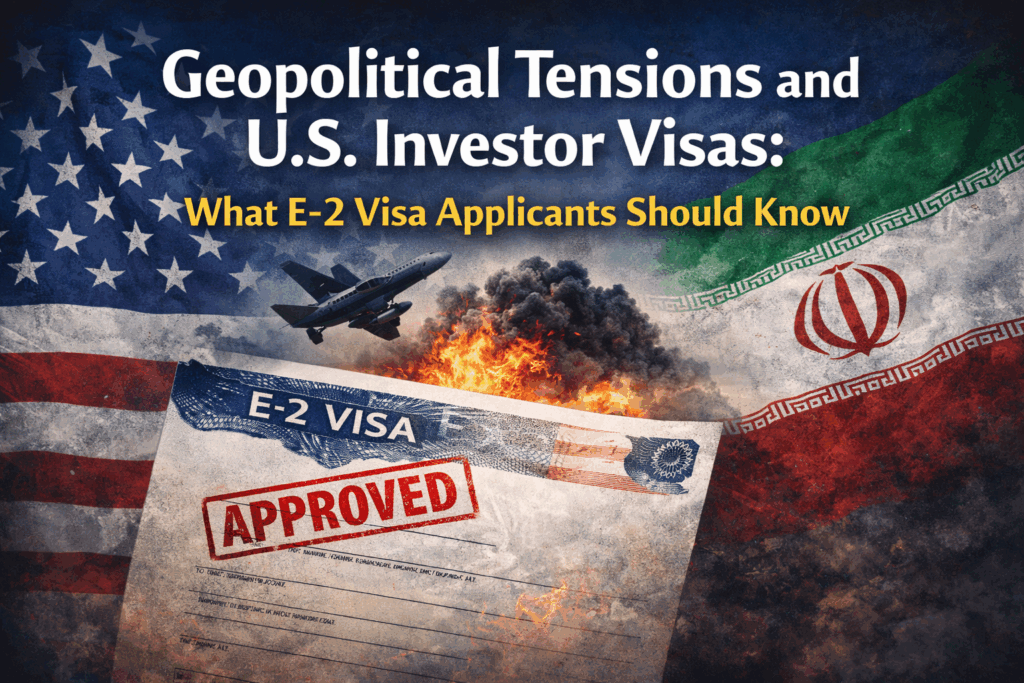
International investors often view the E-2 Treaty Investor visa as one of the most flexible pathways to establish and operate a business in the United States. The visa allows nationals of treaty countries to invest in and manage U.S. enterprises while residing in the United States with their families.
However, the E-2 visa exists within a broader geopolitical and diplomatic framework. Because the visa category is based on treaties between the United States and foreign governments, global political developments—including sanctions, conflicts, and diplomatic disputes—can influence how these visas are issued and processed.
For entrepreneurs planning investments in the United States, understanding the relationship between geopolitical developments and immigration policy is essential.
The Treaty Basis of the E-2 Visa
Unlike many other U.S. visa categories, the E-2 visa is not universally available to all nationalities. Instead, it is available only to citizens of countries that maintain a treaty of commerce and navigation or a qualifying bilateral agreement with the United States.
These treaties establish reciprocal economic relationships between countries and allow nationals of those countries to invest in businesses within the United States.
As a result, eligibility for the E-2 visa is fundamentally tied to international diplomatic relations.
If the United States terminates a treaty with a particular country, nationals of that country may lose eligibility for the visa.
How Geopolitical Events Can Affect Investor Visas
Global political developments can influence immigration policy in several ways.
While immigration laws themselves may not change overnight, geopolitical tensions can impact visa applicants through:
• termination or suspension of treaties
• economic sanctions affecting financial transactions
• increased security screening
• consular processing delays
• diplomatic restrictions between countries
Investors who operate internationally or hold citizenship in politically sensitive regions may therefore face additional scrutiny or legal complexities when applying for U.S. visas. For example, our law office noticed that investors from Pakistan face additional delays due to temporary shutdown of the Embassy.
The Iranian Example: A Case Study
A notable example of the connection between geopolitics and investor visas involves the relationship between the United States and Iran.
For many decades, Iranian nationals were eligible to apply for E-1 Treaty Trader and E-2 Treaty Investor visas under the 1955 Treaty of Amity between the United States and Iran.
However, following heightened diplomatic tensions between the two countries, the United States formally terminated this treaty in 2018. As a result, Iranian nationals are no longer eligible to obtain new E-1 or E-2 visas based solely on Iranian nationality.
This example illustrates how immigration eligibility can change as a direct consequence of international political developments.
It also demonstrates why investors should consider the broader geopolitical context when planning long-term immigration strategies.
Sanctions and Financial Compliance Considerations
Geopolitical tensions may also lead to economic sanctions imposed by the United States against specific countries, individuals, or entities.
Sanctions regimes administered by the U.S. Treasury’s Office of Foreign Assets Control (OFAC) can affect the ability of investors to transfer funds, establish businesses, or engage in financial transactions within the United States.
Because E-2 visa applicants must demonstrate that their investment funds originate from lawful sources and have been properly transferred to the United States, sanctions restrictions may complicate the process for certain applicants.
Financial institutions, immigration authorities, and consular officers may carefully review transactions involving jurisdictions subject to sanctions.
Increased Security Screening and Administrative Processing
Even when a nationality remains eligible for the E-2 visa, geopolitical developments may result in additional background checks or administrative processing.
Consular officers are required to ensure that visa applicants do not pose security risks and that their activities are consistent with U.S. law.
Applicants from regions experiencing political instability or heightened diplomatic tensions may therefore experience:
• longer visa processing times
• additional documentation requests
• extended administrative processing
While these measures are primarily designed to address national security concerns, they can create uncertainty for investors planning business operations in the United States.
Dual Nationality and Strategic Immigration Planning
In some cases, investors hold dual citizenship or may be eligible to obtain citizenship from a treaty country through naturalization or citizenship-by-investment programs.
Because E-2 eligibility is determined by nationality, individuals who hold citizenship from a treaty country may still qualify for the visa even if their other nationality is from a non-treaty country.
For example, an investor with dual nationality may apply for an E-2 visa using the passport of a treaty country.
However, these strategies must be carefully evaluated to ensure compliance with U.S. immigration rules and international legal requirements.
Alternative Visa Options for Entrepreneurs
When geopolitical developments affect eligibility for E-2 visas, investors may need to consider alternative immigration pathways.
Depending on the entrepreneur’s profile and business activities, potential options may include:
• L-1 intracompany transfer visas for executives or managers of multinational companies
• O-1 visas for individuals with extraordinary ability in business or entrepreneurship
• EB-1A immigrant visas for individuals with sustained international recognition
• EB-2 National Interest Waivers for entrepreneurs whose projects benefit the United States
• EB-5 investor visas for qualifying investment projects
Each of these options has distinct eligibility requirements and strategic considerations.
Planning Investments in an Uncertain Global Environment
International investors increasingly operate in a world shaped by evolving geopolitical dynamics. Diplomatic relations, trade agreements, and sanctions policies can all influence immigration pathways.
Entrepreneurs planning to expand their businesses into the United States should therefore take a long-term strategic approach to immigration planning.
This includes evaluating:
• nationality-based visa eligibility
• corporate structuring
• financial compliance requirements
• alternative visa strategies
With proper planning, investors can often navigate these complexities successfully and continue pursuing business opportunities in the United States.
The E-2 Treaty Investor visa remains one of the most powerful tools for international entrepreneurs seeking to establish businesses in the United States. However, because the visa is rooted in international treaties, geopolitical developments can influence eligibility and processing conditions.
Understanding how diplomatic relations, sanctions, and international politics intersect with immigration law allows investors to better anticipate potential challenges and plan accordingly.
Entrepreneurs considering investments in the United States should carefully evaluate their immigration options in light of the current geopolitical environment.
Contact Our Office
If you are considering applying for an E-2 visa or exploring alternative immigration strategies for international entrepreneurs, our firm regularly advises investors navigating complex cross-border immigration matters.
Arif Law Offices, P.C.
Email: contact@ariflawofficespc.com
Phone (United States): +1 (949) 994-6100
Phone (France): +33 1 78 96 87 34
Our firm assists entrepreneurs, investors, and professionals worldwide with U.S. immigration and cross-border business strategies.